jueves, 9 de mayo de 2013

Día de Europa

El 9 de mayo, la Unión Europea celebra el Día Europa, una fecha que simboliza el éxito de la Unión Europea, como el euro, la bandera, o el himno. El Día de Europa es un día para celebrar la paz, la estabilidad y la ciudadanía europea, puesto que todos los europeos nos sentimos parte de un gran proyecto común. El Día de Europa se celebra en los 27 Estados miembros de la Unión Europea con cientos de actividades y festejos que acercan Europa a sus ciudadanos y hermanan a los distintos pueblos de la Unión.

Puedes obtener más información visitando la siguiente web: http://www.hablamosdeeuropa.es/

Bandera de Europa con el mapa de fondo


Monedas y billetes de Euro


Escucha el himno de Europa

miércoles, 8 de mayo de 2013

Neighbourhood

Os presentamos algunas sugerencias y actividades realizadas con el alumnado de 2º de primaria tanto en el área de Science, como en la de Art & Crafts. Trabajamos estas dos áreas de una manera conjunta, de forma que siempre buscamos hacer actividades en la segunda que estén relacionadas con los contenidos de la primera, en este caso los contenidos trabajados son el vecindario y para ello os dejamos algunas sugerencias y material descargable para ayudaros en vuestra case bilingüe.

Modelo de flashcard

En esta unidad hemos incluido el vocabulario referido a los lugares que pueden encontrar los alumnos en su vecindario para hacerlo llegar a su realidad diaria, también se incluyen diferentes profesiones que están relacionadas con los lugares o con las personas que pueden encontrar en las calles de su barrio.
Para introducir las unidades de vocabulario creamos unas flashcards con dibujos de los lugares para presentarlos de manera oral. Las puedes descargar para usar en tu clase. Y también dibujos de los trabajadores.


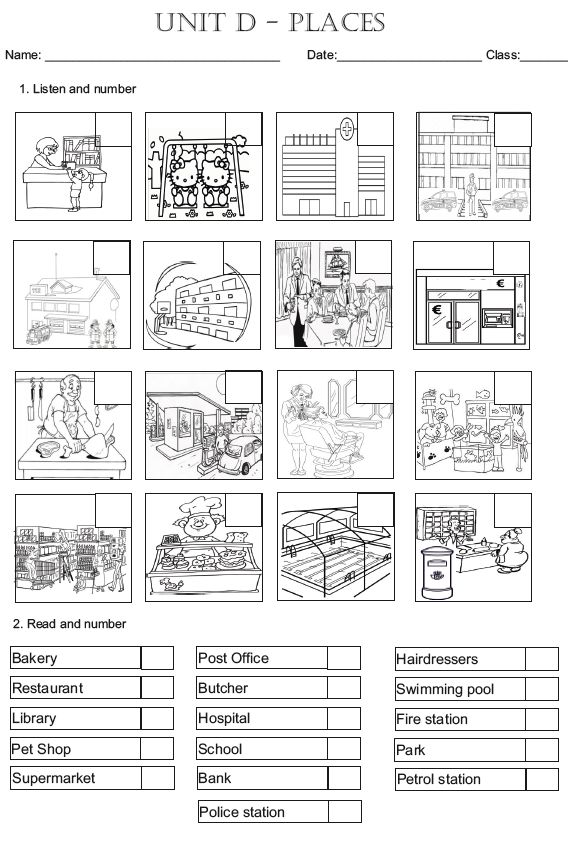
Una de la actividades hecha de manera oral con la ayuda de la auxiliar de conversación fue la siguiente ficha, en ella los alumnos tienen que escribir el número correspondiente a cada lugar una vez que han escuchado las instrucciones dadas.
En la segunda parte deben reconocer las palabras y adjudicarles el número correcto a cada una de ellas según lo completado en la primera parte de la ficha planteada. Con ella trabajamos los nombres de manera oral en primer lugar y a continuación el reconocimiento de palabras escritas.


Modelo de tienda
Como actividad del área de plástica hemos creado una ciudad en 3D, utilizando cartones de leche y zumo, así como cartones de rollos de papel, a los que los alumnos se han encargado de pegar  los siguientes dibujos elaborados por nosotros y que compartimos con todo aquel que le pueda servir de utilidad. Una vez coloreados y pegados se van situando encima de un cartón que ha sido forrado con papel continuo.  Se trabajan tanto los contenidos de los lugares como de las profesiones para llegar a conseguir el resultado final que os mostramos en las siguientes imágenes. Para finalizar se han incluido también algunos elementos como las papeleras o los buzones de correos.


Vista de la ciudad en 3D

Detalle de algunos lugares de la ciudad

Otra vista de la ciudad
Esperamos que os sean de utilidad todas estas actividades que han sido trabajadas con los alumnos de 2º de primaria, pero que pueden ser adaptadas por cada docente al nivel de su aula o emplearlas en las clases del área de inglés.

viernes, 3 de mayo de 2013

Solicitud Cursos CAL 2013/2014

Abierto plazo de presentación de solicitudes para la admisión en Escuelas Oficiales de Idiomas y en cursos de actualización lingüistica para el profesorado. Curso 2013/2014.

El período de presentación de solicitudes de admisión en las escuelas oficiales de idiomas será el comprendido entre el 1 y el 20 de mayo de 2013, ambos inclusive.

Para más información, pinchar en los siguientes enlaces.

  
Estos cursos CAL están dirigidos principalmente a personas pertenecientes a centros bilingües que quieren obtener la certificación necesaria para impartir este tipo de enseñanza en sus centros, o para todos aquellos que quieran pasar a formar parte de personal con cualificación para impartir áreas de primarias en una lengua extranjera en centros con programas bilingües.

jueves, 2 de mayo de 2013

Nuestro ayudante Comenius


My work as a Comenius Assistant in Málaga was a very enriching and rewarding experience. When I arrived in Spain in September I knew almost nothing about this country, I spoke no Spanish whatsoever, and I had a really vague idea of what my work there was going to be like.

Nathänael's corner in the school
I have been extremely lucky as to the person in charge of the bilingual program in the CIEP Salvador Allende. From the get-go, Gracia Sarria Perez has gone out of her way to make me comfortable, help me to find my place at the school, and guide me as to what I should do in her class. I cannot stress enough how rewarding it was to work with such an enthusiastic and dedicated teacher.

I worked with four classes in Salvador Allende, two 3rd grades and two 4th grades. My role in the class has changed a lot depending on the topic, the teacher and the kids. At the beginning of the year, I would take a small group of kids in a corner of the classroom to make simple scientific experiments or investigations, in English of course. Later on, I started to give actual lectures to explain in details a specific point, such as why do the stars shine, how does the brain receive informations from the sensorial organs, etc...
 
At other moments, when the kids were working on an exercise, I would go from one kid to another to see who needed help, give them clues as to how to translate an idea into English words, and so on.
 
And finally, I designed computer presentations on each of the science, geography or history subjects we worked on, as well as on Christmas in different cultures.

I think the flexibility and diversity of these approaches allowed us  to see what worked and didn't work with the kids and to find a way to get each of them interested in the subject at hand. The teachers learned to rely on me, and the kids started to use English when addressing me.

Halloween activity

I believe I learned a lot from the teachers ways of working, and from interacting with the students. On the other hand, I think I was able to give a new point of view on both the scientific topics (having a degree in sciences) and the pedagogical approaches (being a student of Education Science in France, where the methods used often differ.We both learned from each other, and of course having been actively teaching shall be a great help in my future job.

On a personal level, I'm leaving Spain having learned a new language, but also with a new mindset. I believe I learned a lot this year, about teaching, about working in a team, and about myself.


Nathanaël Dufour


lunes, 29 de abril de 2013

Visual language

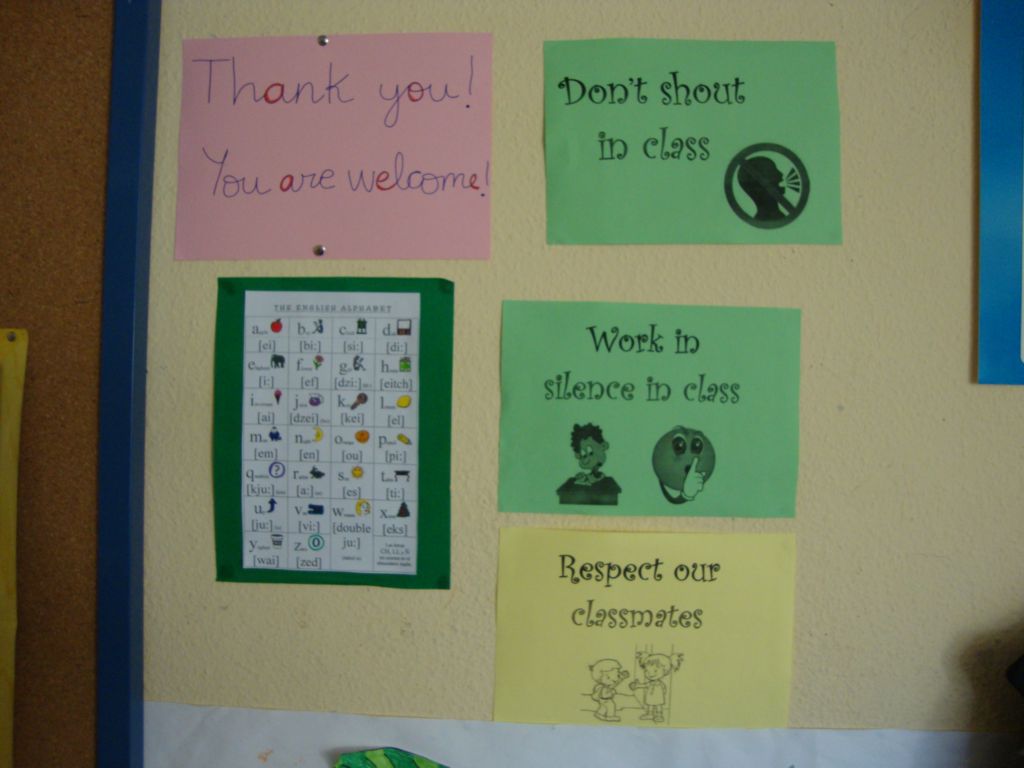
En cada una de las unidades que se trabajan en los diferentes niveles van apareciendo algunas frases que son las más características del vocabulario y el lenguaje trabajado en cada uno de los tópicos, pero hay otro lenguaje que se puede emplear en cualquier área de las que se trabajan en clase y que son estructuras que se emplean a diario. Os dejamos aquí ejemplos de algunas de las expresiones en lengua inglesa que están en las aulas de nuestro centro y que pueden aparecer en el aula de cualquier colegio sea o no con sección bilingüe.

Asking for permission

 Answers


 Classroom Rules


Colours

The weather

Science corner

A todos estos ejemplos se pueden ir sumando las estructuras propias de cada unidad temática y referidas al vocabulario y contenido trabajado en cada una de ellas a lo largo del curso.

miércoles, 24 de abril de 2013

Nuestra auxiliar lingüística

 During the 2012-2013, I have had the pleasure of being a Language Assistant through the program Auxiliares de Conversación at Salvador Allende School in Puerto de la Torre, Málaga, Spain.  During this school year, I worked exclusively with First Cycle, which is made up of both first and second grades.  I was at the school 12 hours per week.  I spent the most time working with 2ºB and they improved tremendously over the course of the school year.


Making materials

A typical day in second grade involved explaining the themes of science class to the students.  Pedro, the teacher that I was an assistant for, and I always tried to provide fun examples to help the students remember vocabulary.  When we were studying the human body, we taped the names of the body parts all over one of the students in order to give them a real life visual.  We also made lots of flashcards and coloring pages for the students to remember the vocabulary for each theme.  Normally, Pedro would lead an activity in one of the second grade classes and I would lead it in the other class.  We worked very well together in the classroom all year and he often asked for my input about the students and I would help to make new seating charts.

 In my opinion, first grade is a more difficult level to teach because it is their first year in primary school and they are still learning how to communicate in Spanish.  A typical day in first grade this year was practicing science vocabulary with the students.  Using visuals, there was no need to translate to Spanish because the students could plainly see and understand the meanings of the vocabulary words.  Sandra, the first grade teacher, and I found it to be the most helpful when I would leave the class in small groups.  In this way, I was able to check the understanding of each student and help correct pronunciation.  It was also very important that I was present when they took the exams because many of them are still becoming used to the school environment and the culture of test taking.

Amelia's talking about USA

 In the beginning of the year, the teachers and I had to discuss proper classroom behavior with our students before we could successfully begin the learning process.  First grade had a lot of things to learn for the first time, such as raising their hands and asking permission to leave their seats.  Second grade had behavior problems from the previous year so we had to start from the beginning with them as well.  In general, if a class' main teacher provides rules and structures, the class will be easy to work with.  However, the students have many teachers with different rules.  If their main teacher does not discipline them, such as taking away recess time and writing notes to their parents, they will not behave for other teachers.  Discipline is an issue for language assistants because we are not supposed to be alone in a room with the students and many times the students do not listen to us when we ask them to stop talking or take away recess time from them.   

This year I was also part of the Bilingual Coordination Team that was made up of the four bilingual teachers of first, second, third and fourth grades, myself, and another language assistant from the Comenius program.  This weekly meeting was very helpful to ask for ideas from the other teachers and to learn what the other bilingual classes were doing to help improve the English skills of their students.  Our coordinator, Gracia, is very organized and helpful to both language assistants and teachers.  She always had ideas and advice for us and knew the things that were happening in each class as well as being an excellent and dedicated teacher to her own third grade class.

In conclusion, this year has been a tremendous learning experience for me both professionally and personally.  I plan to continue working with children in the future and will never forget the two years I spent as a language assistant in primary schools in Spain.

Amelia LeBlanc


martes, 23 de abril de 2013

Día del libro

Con motivo de la celebración del Día del Libro, y para que podáis ver todo lo que se está trabajando respecto a este día os proponemos que visitéis el blog de la biblioteca de nuestro centro donde se detallan todas las actividades preparadas.

Mascota BobBook